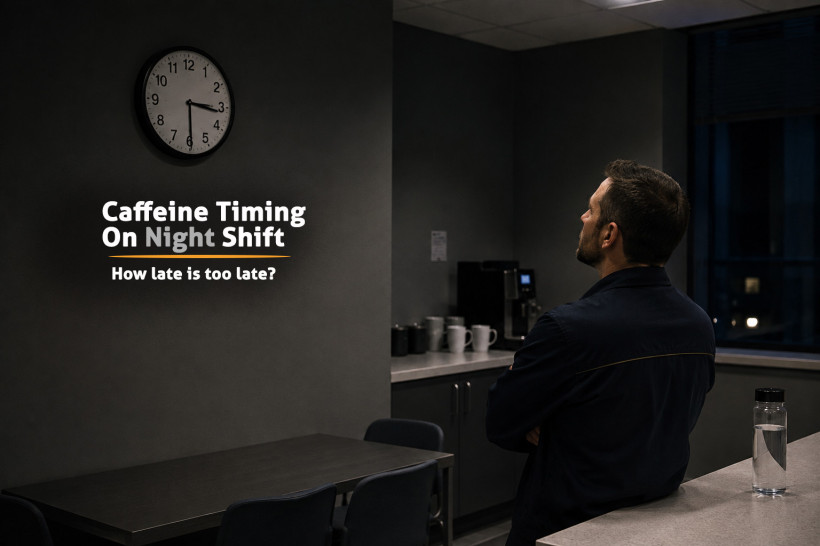
Caffeine can help a night shift feel more manageable, but timing matters when you need to sleep afterwards. This guide explains caffeine half-life, late-shift intake, sensitivity and practical ways to work backwards from your planned sleep time.
Caffeine is one of the most common tools people use to get through nights. That is not surprising. A coffee before handover, an energy drink around midnight, or a tablet when the shift starts to drag can feel like the difference between being barely present and being able to function.
The awkward part is what happens afterwards. Night workers do not just need to stay awake during work. They also need to get home safely, eat something sensible if they are hungry, switch off, and sleep at a time when the rest of the world is waking up. That is where caffeine timing on night shift becomes worth thinking about.
There is no single perfect cut-off time that works for everyone. A nurse finishing at 07:30, a warehouse worker finishing at 02:00, and a paramedic coming off a 12-hour night do not have the same sleep window. The useful approach is to work backwards from the time you realistically want to sleep.
Why caffeine feels useful early in a night shift
Caffeine blocks adenosine receptors. In plain English, adenosine is one of the signals that builds while you are awake and makes sleep pressure feel heavier. Caffeine does not remove tiredness; it changes how strongly you feel some of that tiredness for a while.
That can be useful early in a night shift, especially if you have already been awake for most of the day. Research in fatigued shift workers suggests caffeine can improve some measures of vigilance and reaction time, although the evidence base is not perfect and it does not answer every real-world safety question.
For practical purposes, caffeine is best treated as one part of a wider shift plan. Sleep before the shift, food, hydration, light exposure, movement and workload all matter too. If you are already running on a very short sleep, caffeine may make you feel more alert without fully restoring performance or judgement.
Caffeine half-life in plain English
Caffeine half life means the time it takes your body to clear about half of the caffeine from your bloodstream. If you take 200 mg and your half-life is around five hours, roughly 100 mg may still be active five hours later. Another five hours after that, roughly 50 mg may still remain.
That is only a simple example. Studies show caffeine half-life varies between people. Some research reports an approximate half-life around five hours, while other human pharmacokinetic studies have found values closer to three or four hours in specific groups. Smoking, pregnancy, some medicines, oral contraceptives, liver function, age and genetics can all influence how quickly caffeine is cleared.
This is why two people can take the same drink at the same time and have very different nights afterwards. One person may sleep normally. Another may lie in bed at 09:30 wondering why their body is tired but their brain is still switched on.
Why late-shift caffeine can follow you home
The problem with caffeine before sleep is not only the final dose. It is the total amount across the shift.
Imagine you have a strong coffee before work, an energy drink at midnight, and another caffeinated drink at 04:30. Each dose overlaps with the previous one. By the time you get home, you are not only dealing with the last drink; you may still be carrying caffeine from earlier in the night.
A controlled study in the Journal of Clinical Sleep Medicine found that 400 mg of caffeine taken even six hours before bedtime could disrupt sleep compared with placebo. That does not mean every shift worker must stop caffeine exactly six hours before bed. It does mean that late caffeine can still matter when you are trying to sleep soon after a night shift.
For shift worker sleep, the question is not just, 'Can I get through the last two hours?' It is also, 'Will this make the first two hours in bed harder than they need to be?'
Work backwards from your intended sleep time
Start with the time you usually aim to be asleep after the shift, not the time your shift ends.
If you finish at 07:00, get home at 07:45, shower, eat lightly and aim to be asleep by 09:00, then 09:00 is the anchor. A cautious caffeine window might mean keeping most caffeine earlier in the shift and avoiding larger doses in the final third. If you are very sensitive, you may need a longer gap.
If you finish at 02:00 and aim to sleep at 03:30, caffeine at midnight is much closer to sleep than it feels. For some people it may still be fine. For others, it may turn a tired post-shift wind-down into a restless one.
Try tracking what actually happens. Note the time, caffeine source and rough amount for a few shifts, then compare it with how long it took to fall asleep and how broken your sleep felt. That is more useful than copying someone else's rule.
Coffee, energy drinks and tablets all count
A common mistake is only counting coffee. Caffeine can come from coffee, tea, energy drinks, cola, pre-workout powders, gels and tablets. Strength varies widely, especially with large coffees and energy drinks.
If caffeine is already part of your shift routine, a fixed-dose product can make it easier to keep track of how much you have taken. Shiftworker Nutrition Caffeine 200mg is one example of a known-dose caffeine product. It is still caffeine, and it should be treated as part of your total intake rather than something separate from coffee or energy drinks.
This is not about making caffeine complicated. It is about removing guesswork. If you know the amount and time, you can adjust it.
Example: an 8-hour night shift
For a shift running 22:00 to 06:00, with sleep planned around 07:30 or 08:00:
- 21:00 to 22:30: if you use caffeine, this is usually the simplest time to place it.
- If you use more caffeine later in the shift, consider how close you are getting to your planned sleep time.
- After 02:00: think carefully, especially if you struggle with caffeine before sleep.
- Final hour: consider practical non-caffeine supports where they fit your workplace: appropriate lighting, water, movement, fresh air on breaks, and a planned snack if you are hungry.
This is not a rule. It is a starting point. If you metabolise caffeine slowly, the midnight top-up may be too late. If you tolerate caffeine well and sleep easily, your personal window may be different.
Example: a 12-hour night shift
For a shift running 19:00 to 07:00, the temptation is often to keep topping up through the night. That can build a bigger caffeine load than intended.
A steadier plan might look like this:
- Before or early in the shift: main caffeine dose if you use one.
- First half of the shift: keep intake deliberate rather than grazing from cup to cup.
- Middle of the shift: decide whether you need a small top-up, based on workload and how soon you need to sleep later.
- Last quarter: avoid automatic caffeine. If you are flagging, consider light, movement, hydration and task rotation where your workplace allows it.
Long shifts can make any simple advice look a bit neat on paper. A tough 12-hour night is not the same as a quiet one. Still, placing caffeine earlier usually gives you more chance of sleeping afterwards.
Sensitivity matters
Some people can drink coffee late and still sleep. Others feel one strong coffee for most of the day. Neither group is wrong.
Watch for your own signs: taking longer to fall asleep, waking earlier than planned, feeling wired but tired, heart racing, stomach discomfort, or needing more caffeine on the next shift because the previous sleep was poor. If that pattern keeps repeating, your caffeine timing or total dose may need adjusting.
People with medical conditions, pregnancy, breastfeeding, anxiety symptoms, heart rhythm issues, high blood pressure, or medication interactions should get individual advice from a qualified health professional before using caffeine products.
Wind-down after the shift
Caffeine timing is easier when the rest of the post-shift routine supports sleep. Keep the journey home safe, then lower the stimulation where practical. Bright daylight can be useful during the early part of a night shift, but after work many people find it helpful to reduce light exposure on the way home and keep the bedroom dark and cool.
Eat if you need to, but avoid turning the post-shift period into a second evening. Heavy meals, scrolling, admin and household jobs can all push sleep later. For more on the broader routine, see How to Sleep Better Between Night Shifts and Recover Faster After Night Shifts.
A sensible bottom line
Caffeine can be useful on night shift, especially earlier in the shift, but it has a tail. The later and larger the dose, the more likely it is to still be around when you are trying to sleep.
Rather than chasing a universal cut-off time, work backwards from your planned sleep, count all caffeine sources, and adjust based on your own sleep response. A small change in timing can sometimes make the difference between getting home tired and getting home tired-but-wired.
Related guide: Stay Energized During Long Hours.
Research referenced
- Comparative pharmacokinetics of caffeine and its primary demethylated metabolites paraxanthine, theobromine and theophylline in man - Lelo et al., British Journal of Clinical Pharmacology, 1986.
- The psychopharmacological and electrophysiological effects of single doses of caffeine in healthy human subjects - Bruce et al., British Journal of Clinical Pharmacology, 1986.
- Caffeine Effects on Sleep Taken 0, 3, or 6 Hours before Going to Bed - Drake et al., Journal of Clinical Sleep Medicine, 2013.
- Systematic Review and Meta-analysis of the Effects of Caffeine in Fatigued Shift Workers: Implications for Emergency Medical Services Personnel - Temple et al., Prehospital Emergency Care, 2018.
- Sleep hygiene in shift workers: A systematic literature review - Shriane et al., Sleep Medicine Reviews, 2020.
- Effectiveness of sleep interventions for rotating night shift workers: a systematic review and meta-analysis - Jeon et al., Frontiers in Public Health, 2023.