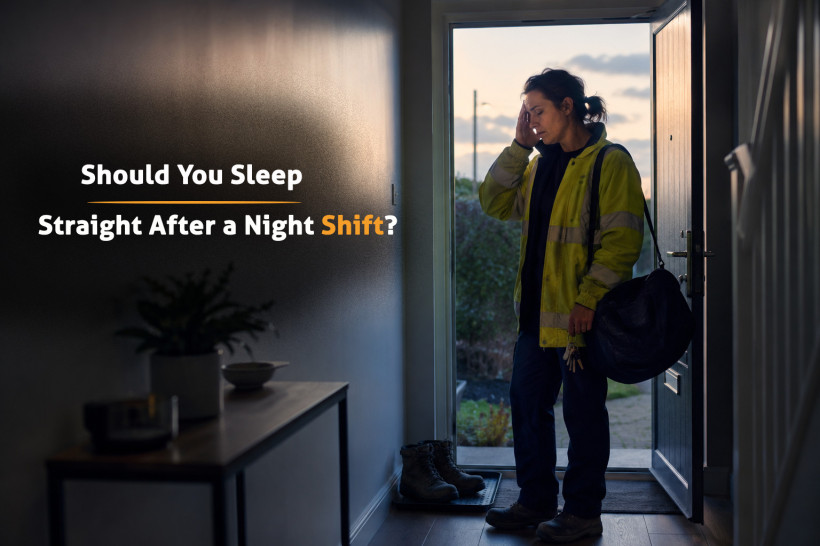
Getting home after a night shift can leave you torn between going straight to bed, staying up for a while, or splitting sleep into two blocks. The best choice depends on whether another night shift is coming next.
Getting home after a night shift can feel oddly confusing. Your body is tired, daylight is arriving, messages are starting to appear, and part of you may want to act as if the day has just begun.
So should you sleep straight after a night shift? Often, sleeping soon after getting home is a sensible option, especially if you are working another night. But it is not the only workable pattern. Some people delay their main sleep. Some split sleep into a shorter morning sleep and another sleep later in the day. After the final night of a run, the decision can be different again because you may be trying to move back towards daytime life.
There is not one sleep timetable that is clearly best for every shift worker. The useful question is: what does your next 24 to 48 hours need from you?
If you are working another night
When another night shift is coming, the priority is usually simple: get enough sleep to be reasonably rested for the next shift. That does not automatically mean you must be asleep the second you walk through the door, but it does mean protecting sleep from being squeezed by chores, scrolling, errands and daytime noise.
For many night workers, going to bed soon after getting home works because sleep pressure is high and the next shift is not far away. A practical version might be: travel home safely, keep light exposure low where possible, eat something light if hungry, wash, then get into a dark bedroom before the day fully takes over.
That pattern also fits common occupational guidance. The Health and Safety Executive suggests trying different sleep times, including sleeping soon after getting back from work or staying up and sleeping before the next shift, then keeping to the schedule that works best for you.
Immediate, delayed and split sleep
Research does not give a single neat answer here.
A 2022 laboratory study tested immediate sleep, delayed sleep and split sleep between two consecutive 12-hour night shifts in 12 healthy young men. The sleep opportunities were 07:00 to 14:00, 10:00 to 17:00, or split between 07:00 to 10:30 and 13:30 to 17:00. Total sleep time and night-time performance were not clearly better in one condition than the others. Split sleep had less wake after sleep onset and more deep sleep in that study, but it also had a longer sleep-onset latency than delayed sleep. The authors concluded that none of the three strategies was clearly superior or inferior.
A 2024 observational study looked at real shift workers in their normal lives. It found morning, delayed, split and mixed sleep strategies between consecutive night shifts. The groups differed in sleep timing, feeling refreshed and regularity, but not in total sleep duration or subjective soundness. That is useful because it reflects real rosters, homes and routines, but it was still a small study and cannot prove that one strategy caused better outcomes.
The practical takeaway is modest: immediate sleep, delayed sleep and split sleep can all be reasonable. What matters is whether the pattern gives you enough total sleep, is repeatable around your roster, and leaves you fit for the next shift.
When delayed sleep may make sense
Some workers find that going straight to bed after a night shift does not work well. They may feel wired, hungry, too exposed to morning light, or unable to sleep because the household is waking up. Others prefer a later main sleep because it reduces the long stretch awake before the next night shift.
One clinical trial in night shift workers with shift work disorder compared a morning sleep schedule, roughly 09:00 to 17:00, with an evening sleep schedule, roughly 15:00 to 23:00. In that specific group, the evening sleep schedule was associated with longer sleep, lower sleepiness, better reported sleep quality and better attention measures, with some findings more prominent among later chronotypes.
That does not mean all shift workers should delay sleep until the afternoon. The study involved people with shift work disorder, and the authors noted limits around generalising to different shift types and shift lengths. Still, it shows why some people may do better when they sleep later between nights, especially if their next shift starts late and they struggle with a long wake period before work.
When split sleep may help
Split sleep means deliberately using two sleep blocks rather than trying to force one long daytime sleep. For example, you might sleep for a few hours after getting home, then sleep again in the late afternoon or early evening before the next shift.
This can be useful when one long sleep is unrealistic. Daytime sleep is often shorter, lighter and easier to disturb than night-time sleep because of light, noise, temperature, family life and normal daytime demands. If your main sleep keeps breaking early, a planned second sleep may be better than hoping you will somehow push through.
Split sleep is not automatically better. In the 2022 laboratory study, split sleep changed some sleep-quality measures but did not clearly improve second-night performance compared with immediate or delayed sleep. In the 2024 real-world study, split sleepers were one of several observed groups rather than the obvious winning group. Treat it as a tool, not a rule.
After the final night of a run
The final night is different. If you are not working another night, you may want to recover some sleep and also shift back towards a more daytime routine.
This is where sleeping straight through the whole day can feel tempting but may make the next night harder. On the other hand, staying awake all day after a night shift can leave you running on very little sleep. A middle-ground approach is often more realistic: have a shorter sleep after getting home, get up later in the day, then aim for an earlier night-time sleep.
That is close to HSE guidance for coming off night shifts: have a short sleep, then go to bed earlier that night. It is guidance rather than a guarantee, and it needs adapting to commute length, childcare, safety-critical duties and how much sleep debt you already have.
A 2020 study of police officers found that sleep duration was reduced after night shift work and that sleep after the last night shift in a series was the shortest and poorest quality in some schedules. That supports what many shift workers recognise: the final night can be awkward, and recovery may need more than one sleep opportunity.
Light, caffeine and the trip home
Sleep timing does not sit on its own. Light and caffeine can push the decision around.
Morning light after a night shift can make it harder for some people to sleep soon afterwards and can also affect circadian timing. Research and consensus work on light exposure suggests that carefully timed bright light and darkness can influence adaptation to night work, but the best pattern depends on whether you are trying to stay on nights or return to days. For everyday purposes, many workers keep the commute home low stimulation where safe, use sunglasses if appropriate, and keep the bedroom dark.
Caffeine matters too. If you use caffeine late in the shift, sleeping straight after getting home may be harder. The companion guide Caffeine Timing on Night Shift: How Late Is Too Late? covers this in more detail, but the short version is to work backwards from the sleep you actually need.
Build the routine around the roster you really have
A good sleep plan has to survive real life. A rotating rota, a 45-minute commute, shared housing, children, noisy neighbours or a second job can all change what is realistic.
For consecutive nights, start by protecting enough total sleep before the next shift. If straight-to-bed works, keep it simple. If it leaves you waking too early or lying awake for hours, try a delayed or split pattern for a few shifts and track what happens.
For the final night, decide whether your main goal is immediate recovery, returning to daytime life, or a bit of both. A shorter post-shift sleep plus an earlier night may help some people bridge that awkward day, while others may need a longer recovery sleep first.
If sleep between nights is regularly poor, the wider routine matters: bedroom darkness, noise control, light exposure, food timing, caffeine timing and how quickly you let daytime tasks invade the sleep window. The guide How to Sleep Better Between Night Shifts covers the practical sleep environment, and Recover Faster After Night Shifts looks at the broader recovery period.
A sensible bottom line
Sleeping soon after a night shift is often reasonable, especially when another night shift is coming. It protects the sleep window before the next shift and keeps the day from swallowing your rest.
But it is not the only valid approach. Delayed sleep and split sleep can suit some rosters and some chronotypes. After the final night of a run, a shorter morning sleep followed by an earlier night may help with the move back towards daytime life.
The evidence suggests flexibility, not a universal timetable. Choose the pattern that gives you enough sleep, works with your actual roster, and does not create a worse problem the next day.
Research referenced
- Timing of Sleep in the Break Between Two Consecutive Night-Shifts: The Effect of Different Strategies on Daytime Sleep and Night-Time Neurobehavioural Function - Sargent et al., Nature and Science of Sleep, 2022.
- Evaluation of sleep strategies between night shifts in actual shift workers - Lammers-van der Holst et al., Sleep Health, 2024.
- Impact of sleep timing on attention, sleepiness, and sleep quality among real-life night shift workers with shift work disorder: a cross-over clinical trial - Cheng et al., Sleep, 2022.
- The effects of the number of consecutive night shifts on sleep duration and quality - Garde et al., Scandinavian Journal of Work, Environment & Health, 2020.
- Working Time Society consensus statements: Evidence based interventions using light to improve circadian adaptation to working hours - Lowden et al., Industrial Health, 2019.
- Bright light, dark and melatonin can promote circadian adaptation in night shift workers - Burgess et al., Sleep Medicine Reviews, 2002.
- Hints and tips for shift-workers - Health and Safety Executive.