Meal timing can become messy when work happens at night and sleep happens in daylight. This guide gives realistic ways to plan night shift meals, post-shift food, hydration and rotating shift meals without chasing perfect rules.
Shift worker meal timing is rarely tidy. You might eat breakfast at 16:30, lunch at 01:00, and something that feels like dinner after everyone else has already started their morning. On rotating shifts, the pattern can change again before your body has caught up with the last one.
That is why strict meal timing rules often fall apart in real life. They assume you control your breaks, your commute, your sleep window and the food available at work. Many shift workers do not. The better question is not, 'What is the perfect time to eat?' It is, 'How can I make eating on night shift predictable enough that I am not relying on vending machines, skipped meals and panic snacks?'
Food quality still matters, but timing affects how easy it is to choose decent food. If you arrive tired and hungry with nothing planned, the choice has already been made for you.
Why shift work disrupts appetite and routine
Humans are not just awake and asleep. Digestion, hormones, appetite and body temperature follow daily rhythms too. Night work asks the body to be alert and sometimes eating at a time when it would normally be winding down.
Research on shift work nutrition suggests that shift workers do not always eat more total energy than day workers, but the timing, food choices and distribution of intake can differ. Reviews also point to meal timing and circadian disruption as plausible factors in poorer metabolic health in some populations, while the evidence for one best real-world eating schedule is still developing.
In practical terms, many workers recognise the pattern without needing a lab study: not hungry before a night shift, starving at 02:00, queasy after a heavy meal at 04:00, then unsure whether to eat before bed. Rotating shifts add another layer because the routine changes just as you start to adapt.
Large meals versus smaller meals overnight
A large meal in the middle of the night can feel comforting, especially during a long shift, but it does not suit everyone. Some people feel sluggish, bloated or more sleepy afterwards. Others genuinely need a proper meal because the work is physical and the shift is long.
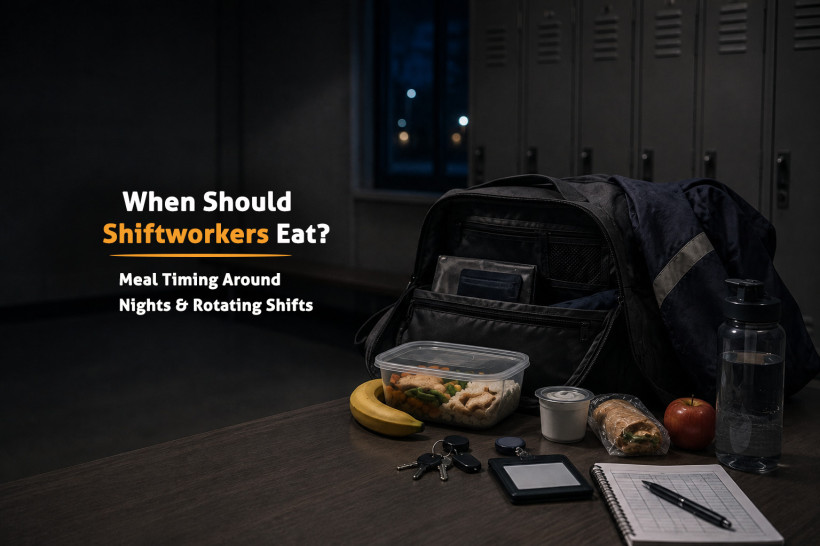
A useful compromise is to front-load the more substantial meal before the shift, then keep overnight food lighter and planned. That might mean a balanced meal before work, then a smaller meal or snack during the shift: yoghurt and fruit, eggs or tofu with rice, a chicken wrap, soup, oats, hummus and pitta, or leftovers in a sensible portion.
The aim is not to be precious about food. It is to avoid the swing between 'I ate nothing' and 'I ate a huge meal at 03:30 and now I feel awful.'
Plan food before the shift starts
The best time to decide what you will eat at 02:00 is not 02:00. It is before you leave home.
For night shift meals, build a simple pattern:
- One main meal before work, with protein, slower-release carbohydrate and vegetables or fruit.
- One planned meal or substantial snack for the shift.
- One lighter option in case the shift runs long or hunger appears late.
- Water or a low-sugar drink you will actually use.
This does not have to mean batch-cooking every Sunday. It can be as ordinary as keeping wraps, microwave rice, tins of fish or beans, yoghurt, fruit, nuts, soup, eggs and frozen vegetables available. The point is to make the default option decent.
For broader food ideas, the existing guide How to Eat Well Around Shift Work is a useful companion piece.
Eating during an 8-hour night shift
For a shift such as 22:00 to 06:00, many people do well with a proper meal before work and a lighter planned option overnight.
Example structure:
- 19:30 to 21:00: main meal before work.
- 00:30 to 02:00: planned meal or snack, depending on hunger and break timing.
- 04:00 onwards: keep food lighter if sleep is due soon after finishing.
- After work: choose based on hunger. Some people need a small breakfast; others sleep better with only a drink and a light snack.
If you finish at 06:00 and aim to sleep by 07:30, a heavy meal at 06:45 may not help. A smaller option, such as toast, yoghurt, cereal, fruit, soup or leftovers in a small portion, may be more practical.
Eating during a 12-hour night shift
A 12-hour night shift usually needs more planning. Trying to get through on one snack can backfire, particularly in physical jobs or busy healthcare, logistics, manufacturing and emergency work.
For a 19:00 to 07:00 shift, you might use:
- 17:30 to 18:30: main meal before leaving.
- 22:00 to midnight: first planned break meal, not too heavy.
- 02:00 to 04:00: lighter snack if needed.
- Final two hours: fluids and small food only if genuinely hungry.
- Post-shift: light, familiar food if you need it before bed.
The exact times will depend on breaks. If your break is fixed, work with it. If it is unpredictable, take food that can be eaten cold, reheated quickly, or split into smaller portions.
Rotating shift meals: keep a few anchors
Rotating shifts are awkward because meal times can become a moving target. Trying to force the same clock-time meals across days and nights may be unrealistic, but keeping a few anchors helps.
One anchor is a main meal before the longest waking block. On day shifts, that may be breakfast or lunch. On nights, it may be an evening meal before work. Another anchor is a lighter pre-sleep meal, especially when sleep is due soon. A third is hydration: keep fluids consistent even when meals move around.
On a run of nights, some people prefer a semi-night routine for several days. On quick rotations, it may be better to avoid fully flipping meals and instead use smaller, practical meals around the shift. There is no perfect pattern. The aim is to reduce chaos.
Hydration matters, but keep it boring
Dehydration can make a hard shift feel harder, but hydration advice does not need to become dramatic. Keep water visible, drink regularly, and adjust for heat, PPE, physical work and sweat.
Be careful with using energy drinks as your main fluid. They can add caffeine and sugar without you noticing, which affects both total intake and, for some people, sleep after the shift. Tea, coffee and caffeinated drinks also count towards caffeine timing, so they belong in the same plan as food.
Food quality still matters
Meal timing is not a substitute for food quality. A perfectly timed pattern of low-fibre, low-protein convenience food will still leave many people hungry and flat. A varied diet with enough protein, fibre-rich carbohydrates, fruit, vegetables and healthy fats is still the foundation.
Supplements do not replace a varied diet, but some people prefer to keep a simple daily supplement routine alongside their meals. A-Z Multivitamin 60 Tablets is one example of a straightforward daily product. UK guidance recommends that everyone consider a daily vitamin D supplement during autumn and winter, with year-round supplementation advised for some people with limited sun exposure. Shiftworker Nutrition Vitamin D3 1000 IU is one option within that wider routine.
Supplements are not a fix for irregular eating, poor sleep or demanding rotas. They sit beside food, not above it.
After the shift: eat enough, but do not restart the day
Post-shift eating is one of the trickiest parts. If you are hungry, ignoring it can make it harder to settle. If you eat a huge meal, that can also make sleep feel harder.
A light, familiar meal often works best before daytime sleep: toast with eggs, porridge, yoghurt and fruit, soup, or a small portion of leftovers. Keep it easy to digest and avoid turning the post-shift window into a long breakfast, scrolling and chores session.
If recovery after nights is a recurring problem, Recover Faster After Night Shifts may help with the wider routine around sleep, light and downtime.
A realistic bottom line
Meal timing for shift workers should be flexible, but not random. Plan before the shift, put a balanced meal before the main work period where possible, keep overnight food lighter if heavy meals make you sluggish, and use a small post-shift option when sleep is due soon.
The goal is not a perfect eating schedule. It is a repeatable routine that survives real shifts: delayed breaks, short sleep, rotating rotas, limited food options and the odd night where everything goes sideways.
Related guide: Stay Energized During Long Hours.
Research referenced
- Energy intake of shift workers compared to fixed day workers: A systematic review and meta-analysis - Bonham et al., Chronobiology International, 2016.
- Dietary Interventions for Night Shift Workers: A Literature Review - Phoi and Keogh, Nutrients, 2019.
- Daytime eating prevents internal circadian misalignment and glucose intolerance in night work - Cheung et al., Science Advances, 2021.
- Dietary Patterns under the Influence of Rotational Shift Work Schedules: A Systematic Review and Meta-Analysis - Flanagan et al., Advances in Nutrition, 2023.
- Navigating Nutrition in a 24/7 World: A Scoping Review of Dietary Intake and Chrononutrition Assessment in Shift Working Populations - Chatterjee and Sahu, Journal of Human Nutrition and Dietetics, 2026.
- Cardiometabolic status among shift workers under meal time regulation: A systematic review of randomized controlled trials - Wulandari et al., Nutrition and Health, 2026.